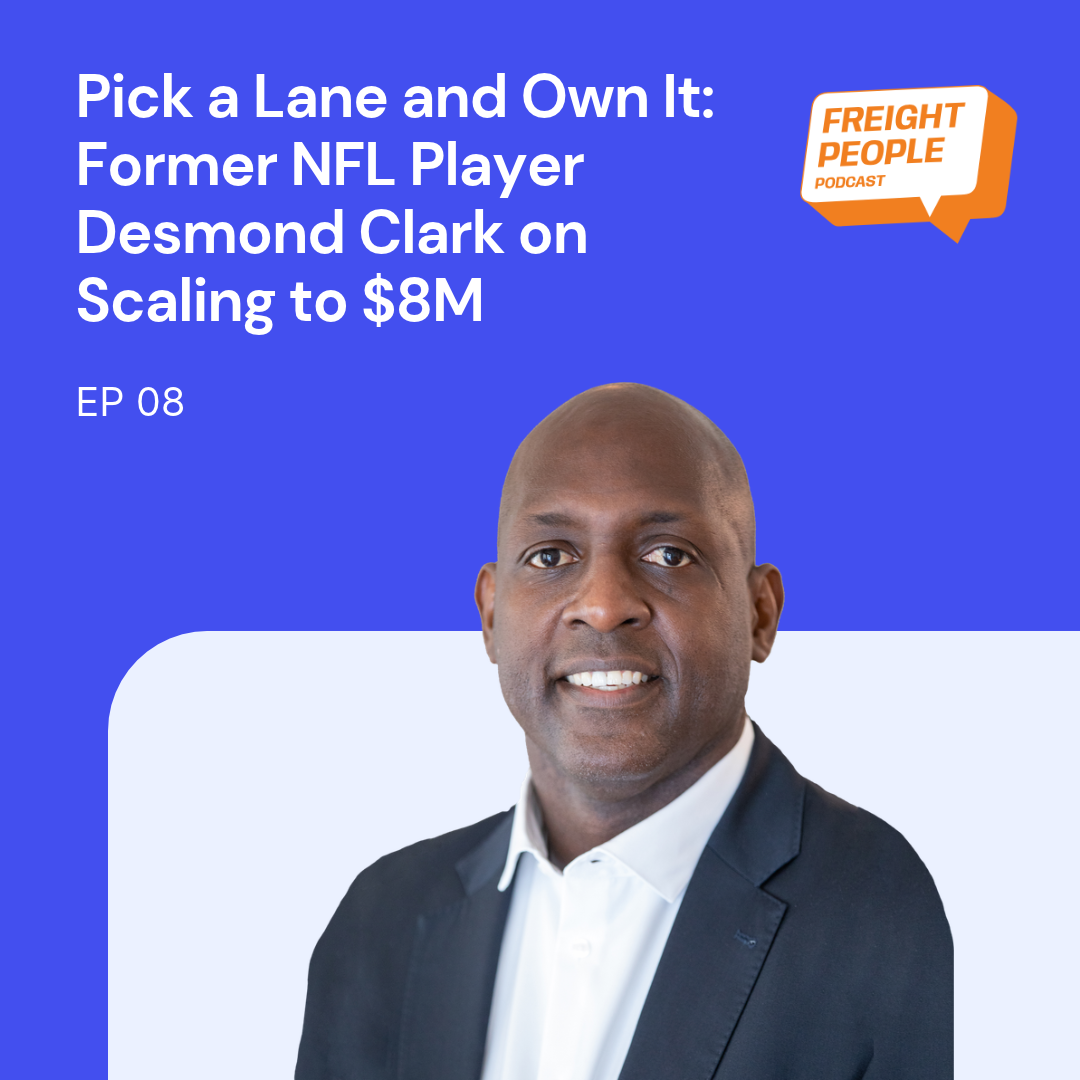


Desmond Clark spent 12 years in the NFL, including a run with the Chicago Bears. He started Bear Down Logistics as a pure brokerage in 2021. He’s scaled it to $8 million in yearly revenue, with deep expertise in heavy haul. Bear Down has run on Alvys TMS since 2023.
In this episode:
- (01:41) Standards over feelings: how Desmond paid every carrier after a customer refused to pay
- (07:21) Vetting past the packet: no VoIP phones, direct calls, and ID checks at pickup
- (09:51) Why Bear Down switched to Alvys, and how a new agent learned it in 30 minutes
- (15:21) Pick a lane: how heavy haul gave customers a reason to call
- (18:27) Sell the service, not the price, and stop losing 3% on credit cards
- (23:35) SEO and AI search: turning 5 to 15 inbound leads a day into customers
(00:27) Welcome and introduction
Ava Davis: Hey Freight People, welcome to the Freight People Podcast. Today I'm super excited to talk to former NFL player turned broker, Desmond Clark of Bear Down Logistics. He started his pure brokerage in 2021 and he scaled that thing to now $8 million in yearly revenue, and he's still growing. So we're going to get into his tips and tricks, how to get started in brokerage, how to scale. Desmond, welcome to the podcast.
Desmond Clark: Thanks for having me on. It's been a while since I talked to you guys. So yeah, thanks for having me on.
Ava Davis: Yeah, well, you're one of our OG customers at Alvys TMS. You've been with us since 2023, I believe.
Desmond Clark: Yes.
(01:10) Why it's called Bear Down
Ava Davis: So excited to get into it. And you had 12 years in the NFL. One of the teams you played for, Chicago Bears. I'm wondering if Bear Down Logistics got its name from the Bears.
Desmond Clark: Of course. That's exactly where it comes from. And, you know, it used to be this saying, I don't hear people saying it too often anymore, but if you got it, flaunt it, right? So that was part of the identity that I had. So, you know, if that's what people know me by, let them keep knowing me by that.
(01:41) Standards over feelings
Ava Davis: Absolutely. Yep. If you got it, flaunt it. That makes sense to me. And you wrote a book on leadership. It's called Principles of Winning. And I think you've used some of those strategies in moving out of the NFL, starting the brokerage. So something you've said about your business: standards over feelings. And I'm just wondering what that looks like in the day to day, and when maybe a load falls apart, when you run into some issues, how that helps you.
Desmond Clark: Yeah, it's, you know, you can feel bad, you can feel good about things. Especially when things go wrong. You can really feel bad about things and you can get in your feelings, but you can't let your feelings get in the way of the standard of excellence that you say that you go out and try to achieve and execute. You know, that's the priority. You can deal with your feelings later after you go out and execute what you're supposed to execute, then, you know, go back and... We're all human, so we're gonna have feelings, but, you know, you gotta be able to put those feelings to the side, look at the problem, look at the issue, look at something that's going on and say, "Hey, how do we need to take care of this?" And we can't take care of it with our feelings. We have to take care of those things with our standards.
(02:55) When a customer stopped paying
Ava Davis: That's good. And like in a brokerage, sometimes you run into issues trying to cover these loads, last-minute mishaps. Do you have a story or an example of when that's come into play?
Desmond Clark: I have a story of the other way around, when we had a customer that closed down on us and said that they were not going to pay their bills. And that was a big blow to me, because they loaded us up with freight in that last month and shut the door, and I think it was intentional. But I had carriers that I had to pay. I couldn't go without paying those carriers. The standard is we treat our carriers like they're part of our business. And I wouldn't let somebody that was doing freight for this business go without getting paid, right? They did the job. So what we had to do is call all those carriers, let them know, "Hey, we're behind, we're gonna be behind, gonna make up for it. We're a profitable business." But instead of 30 days pay, you know, some of the carriers, I asked for 90 days pay, just so we could catch up with that.
And getting them paid, and that's the standard, you know. Did I feel like going up and going to that company and going to see what I can go in there and steal out of their building and go sell, and confront the owner and all that kind of stuff, because I was pissed and I was upset and I was mad? Yeah, but, you know, that wasn't gonna do anything for getting those carriers paid. And we say that we treat our carriers like they're part of the team. So that was the standard. That's what we had to hold to. And they all worked with Bear Down until we got them paid, after we explained the situation. So that's the situation of, hey, it's the standards over feelings.
(04:49) 30,000 carriers and who gets the load
Ava Davis: I love that you're keeping it real. And I bet the other brokers out there can relate to that story, right? Been there. And you've got 30,000 carriers in your network is what I read. And I'm wondering how you decide, you know, which carrier gets the load.
Desmond Clark: So I gotta be honest about this too. When I first started, I started with my guy over at Dray Depot, Brian Rice. And what he told me to do, he was like, just go out and just onboard carriers, onboard carriers, onboard carriers, onboard carriers. And that's what we did. Even if we didn't have loads, we just onboarded carriers. And so that's how we got up to that carrier count. Have we used all of those carriers? Absolutely not. I don't think in our company history that we've done 30,000 loads to give to 30,000 carriers. We did that because of the advice that we had. Everybody goes through that vetting process, but after five years now, we have a stable of carriers that we know that are reliable. We have a lot of the same lanes. We have a lot of the same, especially in the heavy haul, a lot of the same people that we call over and over. But it's one of those things that when we first got started, everybody was new. And then we developed those relationships after, you know, time dealing with people. So that's how you kind of pick which carriers you're gonna use. After the trial and error, and you see the ones who's gonna do the best job and they consider you part of their team and they have that same mindset. So those are the ones that we tend to extend loads to first and foremost.
(06:28) How Bear Down is growing
Ava Davis: The ones that are tried and true, that have worked with you for a long time, that you know you can depend on. You've got that network built at this point. But you're also growing. Can you tell us a little bit about how you're growing at Bear Down?
Desmond Clark: Yeah, so we're growing. You know, we're getting out in the market. We're going to see people, we're going to shake hands, we're getting to the conferences, meeting people. That's one way that we're growing. We're bringing on new agents. So we got a new agency that's coming on. I just actually signed a contract with an agent today, agent agreement. And then we just added on the intermodal division also. So with all those things happening, you know, it's growing leaps and bounds right now, and I'm trying to keep up with everything. A little hard to do, but I'd rather have that than to sit around and be stagnant.
(07:21) How Bear Down vets carriers
Ava Davis: Mm-hmm. Yep. Multimodal. That's gonna be awesome. And as you grow, what is your process to vet new carriers? For the carriers out there that might be listening, I'm curious how you vet carriers and if you've got some processes in place that help you do that.
Desmond Clark: I'm not the one that's vetting carriers anymore. But for my operation guys, we use MyCarrierPackets. We also use eCarrierCheck. The one thing that we do, we go over and beyond just what MyCarrierPackets says. If they say, "Hey, they're good," it's too many smart criminals out here, and they can go and act as if they are, you know, these carriers. So we'll also call and make sure that we talk to the person, and it can't be a VoIP phone. It's gotta be a regular, like, T-Mobile phone. It can't be an internet-based phone. And then we'll also call the company, if it's supposed to be, if it's like not just a single driver. We'll also call that company and make them aware that we're using whoever it is that we're supposed to use. And then we also advise our customer at pickup, check the ID, make sure it is this person. And once you know that it is this person, then you can go ahead and give the load. But usually, like, that upfront, MyCarrierPackets does most of the heavy lifting, but then a few more calls, and making sure that the customer is checking the ID when the carrier gets on site.
(09:00) MyCarrierPackets and Alvys
Ava Davis: Yeah, awesome. So you guys are being pretty careful there. And I'm wondering if your TMS, Alvys TMS, is involved in that process at all?
Desmond Clark: There is an integration. Once the carrier signs all of the necessary paperwork, it automatically updates into the TMS, into Alvys. And then therefore we can go ahead and tender that load as soon as they get that carrier packet signed electronically. We don't have to go and process it over here and then bring it over here. And then it stays in the TMS for whenever we want to use that carrier again. And then also the updates that come from MyCarrierPackets, if, you know, they're late on the insurance or anything like that, you know, we'll get that same information in the TMS.
(09:51) The first TMS and switching to Alvys
Ava Davis: Yeah, that's useful. The integrations, I think, yeah, help a lot. Make the whole thing smoother, make it make sense end to end. So take me back to your first TMS. Do you have any stories about things that didn't work well for you and why you switched over?
Desmond Clark: I was new in this industry. I didn't know anything about a TMS or anything like that. But when I first came in, I copied everything that my mentor did at his logistics company. And after a while I found that it was, you know, you were doing work twice, uploading stuff two or three times, and it just didn't flow, right? We didn't have some of the integrations that we have now with Alvys. And once I got on the phone with Alvys and went through the whole demo, it was night and day just with the demo. And now that we're using Alvys, the biggest thing that I've noticed is just the amount of time that we save using Alvys just to build a load, right?
And even more so now, Alvys has progressed since 2023, where you can just put in the rate confirmation and it practically builds the load for you. So if you got a PO from your customer and you could just put that, upload that into Alvys, it'll build the load for you. And whatever information that's not in the PO, you know, you can go in and do it manually. But there's so many things like that that, even, you know, now, like it wasn't in 2023, that's even better now, that we didn't have with... And I'm not gonna mention any names of any other TMSs, but let's just say it wasn't efficient enough for us, and when we got to Alvys we became way more efficient.
(11:52) Training a new agent in 30 minutes
Ava Davis: Yeah, that's awesome to hear. And we hear that a good bit, that it frees up time. You know, a lot of the workflow automations, and now, you know, we've got a bunch of AI throughout the system, and that it just saves carriers and brokers time. And I'm wondering what you guys do, or what you prioritize, with the time that you get back. What do you think is important for your team to spend more time doing?
Desmond Clark: So I'm gonna answer that just for me, for what I have to do. Today, I onboarded a new agent and I taught her Alvys in 30 minutes. And she was like, "This is simple. This is easy." So me not having to go through it and spend two or three days, and then they gotta come back, ask questions about, "Hey, so how do you do this again?" It is so free-flowing, and all you gotta do is go from box to box to box to box, and it makes it pretty easy to use. I know with our guys that are booking loads, just to go in, send out all of the paperwork, receive the paperwork back, upload it, the invoicing, all of that stuff is pretty, like, just touch of a button. So I'm sure a lot of those guys that I'm using now wasn't here when we had the other TMS. So they don't know the pain that we went through before this.
(13:29) AI features and the help button
Ava Davis: Yeah. Yeah, absolutely. And you know, Alvys has grown a lot since 2023. Are you using any of the AI features?
Desmond Clark: Yes. Not me personally. I know some of the guys, they're probably using the AI features, but, you know, I'm not the one on Alvys, and I have a whole ops guy that, he runs all of that stuff on Alvys. So I just know that I don't have any issues coming up to me about the TMS and about, you know, loads being built and those type of things, which makes my job easier. And you're talking about saving time for me, you know, I was able to hand that off to someone, and now there's no issues and no problems that's coming back to me that I have to bring back to you guys and say, "Hey, can we get this fixed? You know, what's going on with that?"
And I could tell you this: when we do have a minor problem, which we haven't had one in months, it was always go to the help button, put your problem in, and within 10 or 15 minutes, boom, you got somebody that's there and they have already fixed the problem. So I used to absolutely love that help button when I was the one that was overseeing, you know, everything with the TMS. That was great. That customer service side of everything that Alvys has also is, like, beyond any other kind of... like when it comes to QuickBooks, when it comes to, like, factoring and all of that, all of the tech stack that we have, I think Alvys is probably the best with the customer service side of everything also.
(15:21) Advice for starting and growing a brokerage
Ava Davis: Yeah, that's good to hear. We also hear that a good bit, talking with carriers and brokers using Alvys. And so you're the strategy guy. You're sort of at the top of the organization, planning how to grow, how to increase efficiency. So I'm wondering, if there are brokers out there that are looking for some advice, what advice you typically give brokers on how to get started? And then those that are started, how to grow, things that you've learned.
Desmond Clark: Yeah, so, and you're talking about people with companies, not like broker agents, correct?
Ava Davis: Mm-hmm.
Desmond Clark: Yeah, so I think that that initial tech stack is definitely important. You know, I talked to some people and they say people are still out here running companies without a TMS system. I just talked to some people last week and it blew me away. I don't even know how you run a company without a TMS system. So for anybody that's starting right now, get a good TMS system. A TMS, I should say. Get a good TMS. That's the most, because that's what you run everything through: all your loads, all your invoices. Even with your factoring, if you got a good TMS, it's gonna go through the TMS.
But if you wanna grow, this is what I found out on accident: you really have to have a reason why people should call you. And what I mean by that is, when we became a heavy haul company, we developed the expertise in heavy haul. Now people say, "You know what? Bear Down Logistics is a heavy haul company. They have an expertise in something." And that's when we started to grow, when we were able to say, "This is what we do." You know, before that we was just a broker. Anything and everything, we was trying to move. But now that we can say, "Hey, this is what we do," it gives people a reason to search for us and call us.
Ava Davis: Mm-hmm. So maybe you would recommend, like, picking one area to really go deep and develop your expertise, and let everybody know you understand heavy haul, for example.
Desmond Clark: Mm-hmm. Exactly. And we still do all of the flatbed and the dry van, and we still do box trucks, all of that stuff. But, you know, what are you going to excel at? What are you gonna hang your hat on and say, "This is what we do the best," right? Because if you're trying to do everything, there's just too much competition for everything. So I would say, hey, pick a lane that you wanna travel and become the best in that lane. And the pun is intended.
(18:27) Where brokers lose money
Ava Davis: Pick a lane, become the best in that lane. I'm wondering if you notice places where brokers lose money, that they may not even realize they're losing money in this area?
Desmond Clark: Yeah. One of the... I mean, this was just for me. I just figured out the whole credit card thing, because we have some people that pay up front, right? And I was losing that 3% on the credit cards. And one of the things that I wasn't focused on was making sure that my brokers were adding that extra 3% to the credit card charges. That was one way that I'm still going back and looking at how much money we actually lost.
Another big way is that a lot of people, a lot of brokers, they sell on price. Right. We don't necessarily try to make sales off of price. We try to make sales off of the value that we could bring to people. If you go back and talk about the heavy haul, there's not a whole lot of companies out here that I know that have a turnkey service like Bear Down Logistics, where they give us the project and we can handle everything from all of the surveys to getting a crane. The soil needs to be tested to make sure it's dense enough so we can put a crane that can lift a half-a-million-pound transformer, and the crane won't tip over because the soil is not compact enough. We can do all of that type of stuff. We can go out and get the extra insurance. Whatever it is that we need to be able to do to move a load, you can turn that whole project over to us.
And we more so see ourselves like a project manager rather than just a logistics company. So when you're able to sell that type of service, you know, you can charge an extra premium on that also, which gives you the higher margins. I would say, if a company's out there, sell the service, don't sell the price, because you got way too many people selling on price. But once you can educate people on your service and they understand it, and they understand that they're getting a little bit higher service than someone else, most of the companies would be willing to pay a percent or two higher than what they would have paid just to get a truck and move freight.
(21:12) The Montgomery ruling and carrier selection
Ava Davis: Yeah, and it's peace of mind, you know, for your customers. It's like, I know Bear Down can handle all of these nuanced pieces, and maybe it's safety related or equipment related or whatever. They trust you to handle the whole thing. Like you said, project management. That makes a lot of sense. I'm wondering, like, with the way recent news has changed, some of the liability comes back to brokers sometimes. I'm wondering if you have any processes that protect you if, like, your carrier were to get in an accident or have an issue.
Desmond Clark: Well, when it comes to the Montgomery ruling, right, my understanding of that is that you have to have a well-defined process of selecting carriers. I would recommend companies like FlexShield that we use. They actually say, "Hey, when we vet a carrier for you," they actually go through a time step process. And then they can actually send you that process. So if a carrier was actually to get into an accident, we have proof that, hey, this is a standard process that we always take to vet this carrier. And therefore we should be covered, you know, from that ruling that came down in the Montgomery ruling against C.H. Robinson.
Ava Davis: Mm-hmm. Yeah, that makes sense. Okay. So having a good process, trusting your process, makes you feel more protected.
Desmond Clark: Right. Defining that process and making sure that your operation teams is following that process every single time. No corners cut. Because as soon as you cut that corner, that's gonna be the one thing that comes back and just devastates the company. Because there's a lot of great carriers and drivers out there. There's enough where we can get things moved with good carriers.
Ava Davis: Mm-hmm. Yeah. And like you say, building trust with your carriers, working with them time and again, having your own network, just like your customers have you in their network. They know they can trust you to manage the project well. You've got a network too.
Desmond Clark: Absolutely.
(23:35) Finding new customers with SEO
Ava Davis: Yeah, that makes sense. Okay. Last specific question for you. I'm wondering if you have any tips or advice on how to find new customers as a broker.
Desmond Clark: Man, that's a hard one, because we don't do any outbound calling, right? And that's what most people do. We get out into the market, we go to the conferences, but the way that we have been getting most of our customers over the last two years is that we developed an SEO process with an outsourced company to get inbound leads, right? Being ranked high in Google for the things that we do, in certain areas that we can service, those areas with the highest capabilities and standards. So I can't tell you what the SEO team does, because I don't know. I know they're the experts at that, and they say, "Hey, you pay us this amount and then you can expect this." And they've done a really good job of getting us, you know, five to 15 inbound leads just about every day. And out of those five to 15, you know, one or two of those turns into something almost every day.
(25:08) Showing up in AI search
Ava Davis: That's fabulous. Yeah. And so when the customers are searching for a good carrier, this company is helping you guys create the content and get the message out there, so that you will come up in the search results when they're searching.
Desmond Clark: Correct, correct.
Ava Davis: And now it's, you know, it's AI search that a lot of people are using to find a solution, you know, to find a broker or carrier when they need it. And so I bet the company is helping you there too, to help you guys be more visible with AI search.
Desmond Clark: Absolutely. And we can go back and research that journey of where that lead came from. And a lot of leads do come from ChatGPT and those type of searches. So, and that's the next wave, right? Everything is going towards AI. So just about everybody gets on the computer: "Hey ChatGPT, give me such and such and such and such." And it just comes up. So yeah, if you're not doing that, you're falling behind. From what I've gathered, just talking to people over, you know, the last few months or a year, year and a half or so, is that the whole picking up the phone and dialing, it was already excruciating to do, but it's even more excruciating now, because people are finding their providers in a different way now.
And then, I like the old-school way. I like getting on the phone with people, developing relationships, asking them, "Hey, so who do you know that's a big-time connector?" Or, "Who do you know in this industry?" Or sometimes, "Who do you directly know in a company?" But when you get out there with the people and develop that network, and you're not only asking for things, you're actually giving value also, you know, that's the most solid way that I believe that you can build a client base. Because when people are willing to basically introduce you and walk you into the door, now you get to borrow from that person's trust that they already built with the person that they're introducing you to. You know, Ava, if you introduce me to somebody, they're gonna say, "Well, if Ava introduced me to them, then they must be okay, because we trust Ava," right? So I get to borrow your trust until I could develop my own. And I think that's the best and most solid way to build a book of business.
(27:44) Why AI search rewards word of mouth
Ava Davis: Yeah, I totally agree. And especially in logistics, you know, it's about those relationships, investing in people, and your people working their networks of people. And interestingly, because AI is intelligent, what I've noticed from a marketing perspective is that it uses a similar methodology that a human would use. So it's like, when I need a recommendation for a carrier or a broker, I'm going to ask the people I know. I want to know what other humans say that have worked with them. You know, I may not need to go and read everything on their website, but I want to know what other humans say that have worked with them. And AI is looking for those kind of voices too. So they'll, you know, search things like Reddit, where humans leave reviews, or any kind of third-party review sites. I feel like those are becoming more important, because the AI search functions are also trying to surface word-of-mouth recommendations of companies and products and everything. So I feel like it's really important now, maybe more than ever, to rely on a network of people and build relationships and build trust, just like you said.
Desmond Clark: Yeah, I mean, that's the foundation of everything, if you ask me. Relational trust. Like, if you can develop that, then it may take a little while for it to all come together, but when it comes together, you know, now you have a solid foundation, and there's really no stopping you at that point.
(29:23) Final advice: believe in yourself
Ava Davis: Yeah, I totally agree. Well, Desmond, it's been such a pleasure to get to talk with you and to hear some of the things you've learned over the years of scaling your brokerage. Is there anything else, any other piece of advice that you'd want to share before we go?
Desmond Clark: Just the only other thing that I would say: hey, if you want to be successful, not just here in logistics, but anywhere, man, just develop that belief in yourself. And I believe that's where it really, really originates from. If you can eliminate the doubt, eliminate any of that fear, which is gonna come up at different times, but just eliminate that and just keep moving forward. Believe in yourself, believe in your convictions, and put all of the other distractions to the side and just go get what you're going after.
Ava Davis: I love that. And that means a lot coming from you, because you've been successful in professional sports, and now as a broker, you know, two very different things. And what I'm hearing is that you believe in yourself, and you know how to push doubt and fear aside so that you can go after what you want.
Desmond Clark: Absolutely. Those are just roadblocks, and you gotta knock them out of the way. Like, "Nah, that's a lie." Or, you know what, "What am I really scared of?" And just get it out the way.
(30:49) Where to find Desmond
Ava Davis: I love that. That's powerful. Now, where can people find you if they want to see more about what you're doing or what your company's doing, or learn more?
Desmond Clark: Yeah, I do a lot of content on LinkedIn. Like, I write just about every day. We also have a podcast of our own now, Bear Down, Level Up, where you can find that on YouTube. So go over there, check it out. We have a lot of fun, and then we also have great interviews over there too. So those are the main two places if you want to catch up with me or Bear Down Logistics and find out more information. And of course the website, beardown-logistics.com.
Ava Davis: All right, awesome. Well, thank you so much, Desmond.
Desmond Clark: Thank you for having me on.


More Episodes



About the Show
Freight People is a podcast where logistics professionals share the insights, strategies, and real-world stories behind their success. Hosted by Ava Barnes, this podcast is brought to you by Alvys - the leading transportation management platform.
Episodes feature candid conversations and practical advice to help carriers, brokers, and fleet managers grow and optimize their freight operations.