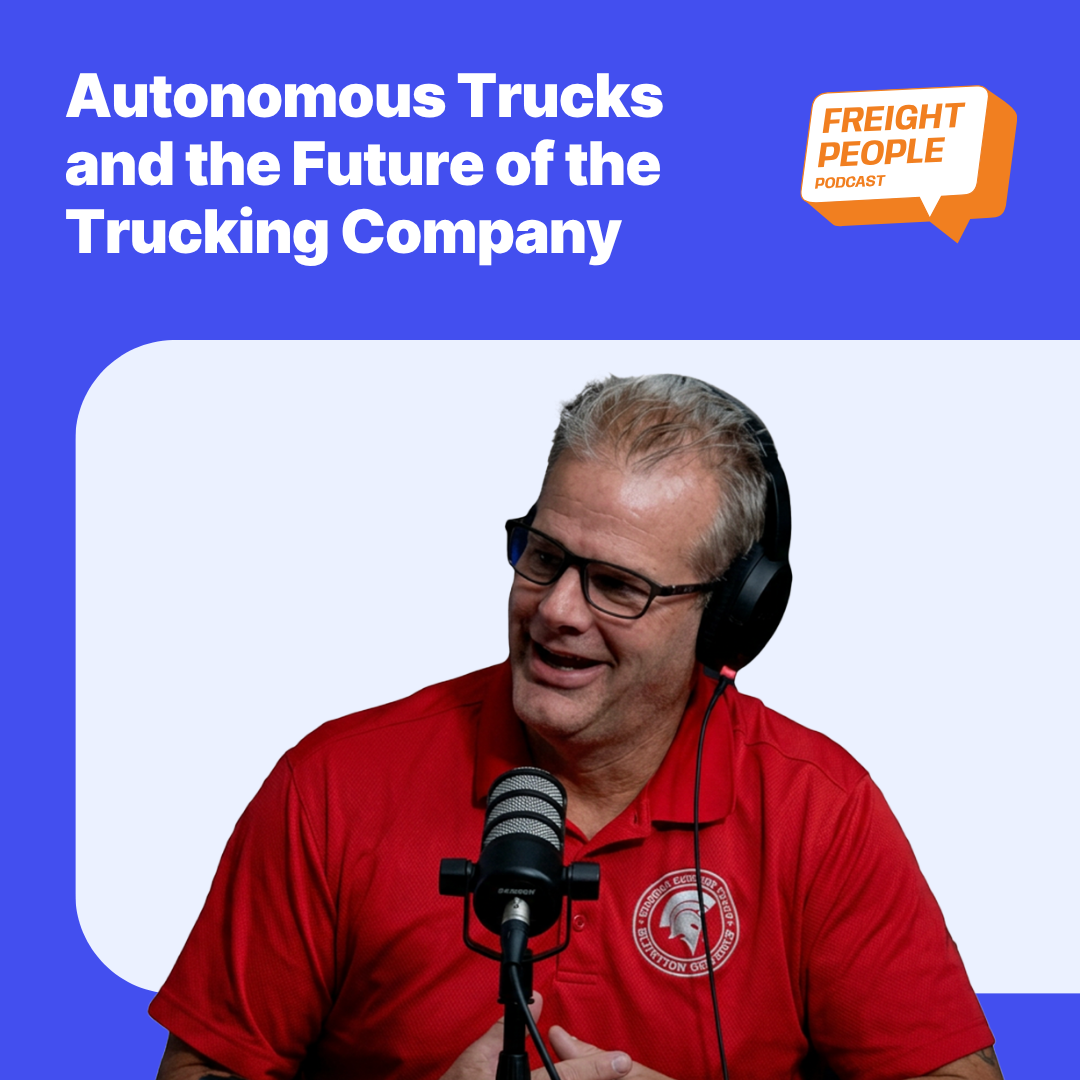


Mike Vincent has spent nearly 40 years in freight. Founding team at FreightWaves. Seven years hosting WHAT THE TRUCK?!?. Today he's EVP of Strategic Growth at Spartan Carrier Group and runs its media arm, 146 Media.
In this episode:
- (02:07) Why the driver shortage finally turned real
- (05:47) What happens when the tractor and trailer become the operating system
- (10:44) Why grey fleets may replace the trucking company itself
- (13:18) Where a carrier should actually start with AI
- (15:49) What Alvys Foundry Agentic Platform gives carriers who want to build their own tools
- (25:49) The logistics problem hiding inside plastic recycling
Full chapter list:
- 00:49 Autonomous trucks: what's real and what isn't
- 02:07 Why the driver shortage finally turned real
- 03:21 9,500 CDL mills shut down
- 03:42 The Louisiana bribery scandal
- 04:22 Why Spartan's driver turnover runs lower
- 05:16 Aurora, Fort Worth, and the Alvys integration
- 05:47 When the truck and trailer know everything
- 06:21 "Eventually you're not going to need a trucking company"
- 06:59 Outrider, yard automation, and running a yard in 1991
- 07:50 Brick phones and why the curve doesn't stop
- 08:58 One connected network: Qued, CarrierSource, Sonar, APIs
- 10:44 Grey fleets and why FreightVana already has trailers
- 11:33 What carriers should be doing today
- 12:23 Disruption, and the IBM guy who called the laptop a fad
- 13:18 Where to actually start with AI
- 14:09 AI is a tool, not the solution
- 14:52 The blockchain lesson
- 15:49 Alvys Foundry, in Mike's words
- 18:33 Choose your adventure: prebuilt agents or build your own
- 19:17 Where humans fit as AI advances
- 20:22 AI video silliness, good intentions and bad
- 22:09 Knowledge versus intelligence
- 22:18 The dead internet theory
- 23:14 Human-made as the new organic
- 24:35 The driver as exception manager
- 25:49 Guitar picks, ocean plastic, and a logistics problem
- 26:24 Micro recycling plants in a 40 foot container
- 27:32 Six cents a pound to 47 cents a pound
- 30:50 Stewardship without the politics
- 32:00 Nothing is unrecyclable, the infrastructure just isn't there
- 32:21 Plastic bags and backhaul logic
Freight People Podcast: A Hundred Years From Now, with Mike Vincent
Full episode transcript. Lightly edited for clarity.
(00:00) Cold open
Ava Davis: A hundred years from now, what it's going to look like, with Mike Vincent.
(00:07) Meet Mike Vincent
Ava Davis: Hey Freight People, welcome to the Freight People Podcast. Today I'm very excited to sit down with Mike Vincent. Mike's been in freight for almost 40 years. He was on the founding team at FreightWaves, and he hosted WHAT THE TRUCK?!? there for seven years. That's how I first encountered you, Mike. And now you're EVP of Strategic Growth at Spartan Carrier Group, and you're leading their media arm, 146 Media. So you know a lot about trucking and freight.
Mike Vincent: Yeah. I started when I was about five.
Ava Davis: Got it. Started young. There are so many things I want to pick your brain about, but I wanted to start with autonomous vehicles, because we're here in Dallas Fort Worth where you guys are based, and we're seeing more autonomous semi-trucks coming out of Dallas.
(00:49) Autonomous trucks: what's real and what isn't
Ava Davis: What's your take on where the industry is right now?
Mike Vincent: It's an incredible technology. I mean, you and I both have autonomous cars, and they're fantastic.
Ava Davis: Guilty.
Mike Vincent: Yeah, you're guilty. But they're super cool, right?
Ava Davis: I thought I was going to be super nervous getting in one. It's the chillest thing ever.
Mike Vincent: It's awesome. It really is. But with the autonomous trucks, there's a lot of hype around them. A lot of it's true, a lot of it's false. The hype around how good they are, how efficient they can be, what they can actually do? That isn't hype enough. It's a lot more than people realize. But the hype around the danger of getting rid of all the drivers, you need to squash a lot of that. It's just not true.
Ava Davis: You're not worried about that. Why not? What's going to happen to jobs?
Mike Vincent: Well, there's going to be attrition. Like any industry, it shifts jobs. And right now, at the pace we're going, exacerbated a bit by certain political climates, what used to be a false narrative on driver shortages is actually real. And growing.
Ava Davis: What do you mean?
(02:07) Why the driver shortage finally turned real
Mike Vincent: We've heard there was a driver shortage forever. There really wasn't. It was just that everybody's turnover was 125%. We had a turnover issue. But we were flooding the market with drivers, and that was lowering rates. You had this glut of capacity, especially over the COVID years. It exploded.
So now you've got a supply-driven rate increase, a supply-driven market strength, which is precarious. When it's demand-driven, it's much more sustainable as an upswing. But we legitimately have a constraint on capacity now, and that's going to continue. We've got aging driver populations. You've got interest in other things. It's harder to recruit drivers.
(03:21) 9,500 CDL mills shut down
Mike Vincent: And you don't have the influx of drivers going through CDL mills. Ninety-five hundred have shut down, and growing. CDL schools.
Ava Davis: That's a lot. Why are they shutting down?
Mike Vincent: Because they were CDL mills. They were pumping out people who weren't qualified. No name given on their CDLs. Can't speak any English. Don't know what a pre-trip is. All that stuff is getting blown away.
(03:42) The Louisiana bribery scandal
Mike Vincent: Just recently there was the bribery scandal in Louisiana, where they were paying government officials five grand to sign off on a certificate. So all those things are going away.
I'm just saying there are a bunch of different reasons why there are fewer and fewer drivers, and there are going to be fewer and fewer going forward. So I'm not really worried. Attrition is going to get replaced. Plus there are certain areas where drivers don't want to be doing the work anyway.
(04:22) Why Spartan's driver turnover runs lower
Ava Davis: Driver turnover is a big issue, like you mentioned. I feel like Spartan Carrier Group actually stands out in that you guys have a lot less turnover. Having come from so many different places in freight, what do you think Spartan does better or different?
Mike Vincent: First of all, they're in a segment that inherently has a lower turnover rate for drivers, because it's managed dedicated operations. Regular routes, regular volumes. You actually do have weekly home time. There are no minimum miles or stops, because of the business we do. So there's that.
But then there's the culture that Carlos and Martha built, which is Christian and family-based first. The company truly is God, family, company. That's the order of importance. And drivers resonate with that. They feel more secure.
Ava Davis: Things are more predictable.
Mike Vincent: They understand when they'll be home, and their home time is respected. Absolutely, from the top down.
(05:16) Aurora, Fort Worth, and the Alvys integration
Ava Davis: Talking about autonomous trucks, Aurora is running driverless freight out of Fort Worth. And Alvys TMS has an integration with Aurora. We're trying to help the companies that are more interested in using autonomous trucks, to allow that integration so things flow more freely. And that's right here in your backyard. What's your read?
Mike Vincent: I personally think it's really cool. I'm very interested in it. I think it's awesome. Because I see an endgame where they're all connected.
(05:47) When the truck and trailer know everything
Ava Davis: What do you mean?
Mike Vincent: The trucks know everything. If the trucks and the trailers know everything, they don't need anybody. They don't need a dispatcher. They don't need anything.
If you extrapolate it out to where it's going to be eventually, a hundred years from now, fifty years, sixty years, whatever it happens to be, that's what's exciting to me. I'm not saying next week. It's like everybody argued that the voice broker was going to go away. That's still a fact. It will go away. It just didn't happen by 2015, when everybody thought it would.
(06:21) "Eventually you're not going to need a trucking company"
Mike Vincent: Eventually you're not going to need a broker. You're just not. It's just like eventually you're not going to need a trucking company.
Ava Davis: Oh my gosh.
Mike Vincent: It's going to take a long, long time.
Ava Davis: Mike is living a hundred years from now.
Mike Vincent: Well, you just watch the natural evolution of what's going on. Look, our kids don't even know what "hang up the phone" means anymore.
Ava Davis: That was like yesterday.
Mike Vincent: Hang up the phone? What do you mean, press the button?
(06:59) Outrider, yard automation, and running a yard in 1991
Mike Vincent: And I think it's really cool that it's happening right in the backyard, because there are a lot of really cool things happening in the autonomous vehicle space. One of them is Outrider, which does yard movement and that kind of thing.
Man, what I would have given to have that type of system when I was at Roadway Express trying to run a yard in 1991. To actually know where everything is, and not have to recruit CDL drivers to get in and out of a yard hostler several hundred times in an eight-hour shift. These are jobs that drivers don't want anyway.
Ava Davis: And warehouse operations. We're seeing a lot of robotics there. It feels like the technology's going to take off within the next five or ten years.
Mike Vincent: It's going to be a hockey stick, just like a lot of things.
(07:50) Brick phones and why the curve doesn't stop
Ava Davis: I want to unpack the vision you breezed over. If I'm hearing you correctly, you think the tractors and trailers themselves are going to be intelligent. They're going to be the operating system.
Mike Vincent: I'm not saying in two, three, five years. That's not what I'm saying.
Ava Davis: I love it though. Where are we going?
Mike Vincent: This is where it's going. Why would it stop? It doesn't typically stop.
Ava Davis: No, it doesn't typically stop.
Mike Vincent: Look at cell phones. Brick phones. I don't know if you're old enough to remember the brick phones. You were cool because you were carrying a fifty-pound bag.
Ava Davis: It was in the console of the car?
Mike Vincent: Yeah. Or you had the bag. The cool guys had a bag that weighed fifty pounds with a phone in it. You looked like somebody in a war movie. Like Lieutenant Dan calling something in. You were cool then. Now you've got a computer in your hand. You literally have all the intelligence in the world that ever existed, right there in your hand. It's not a phone.
Ava Davis: We're already cyborgs in a way.
Mike Vincent: I'm just saying, why would it end?
(08:58) One connected network
Ava Davis: What's your vision? The trucks are going to be the computers, all in one?
Mike Vincent: Sure.
Ava Davis: What does that look like?
Mike Vincent: You have a network of trucks that are all intelligent and understand what's going on. You're already connecting to ERP systems with TMSs. You're already connecting inside the four walls with different things. Qued is fantastic for that. You've got TruSygnal, you've got CarrierSource, you've got all these disparate technologies showing who's looking for what type of capacity, on what lanes, right now, and how often. CarrierSource type of stuff, where you can go in and actually see who needs freight. You've got SONAR, which used to be FreightWaves. Now they're kind of separate. We won't get into that whole thing.
All those disparate data points can feed in through API. And you've got this massive computing power and AI intelligence on top of it, and all the autonomous sensors. Why would there be trucking companies eventually? Won't the OEMs eventually just be spitting out trucks that are ready to go?
Tell me I'm wrong. Why does it stop?
Ava Davis: Luckily it won't be tomorrow.
Mike Vincent: It won't be tomorrow, folks. It won't be tomorrow. But that's where I see things going. Why wouldn't it go that way?
You've already got Qued in there. You've got technologies that can take the production system in a warehouse and line up the priorities of shipments. You've already got procurement systems that tell you to start purchasing this raw material or that raw material, and to change it from this location to that location because of geopolitical events. So why isn't all of that put together?
(10:44) Grey fleets, and why Freightvana has trailers
Mike Vincent: If you put all that stuff together, you've got grey fleets. Do you not? And we're already seeing it. Look, Freightvana has trailers. They're a broker. Why do they have trailers?
Ava Davis: Isn't that a grey fleet? You tell me, Mike.
Mike Vincent: Well, it's starting to be, right? Because anybody can pull those. It doesn't matter what the power unit is. So why isn't there grey power? Because they're not all autonomous yet.
Ava Davis: That's the missing link.
Mike Vincent: Why wouldn't it be? If they're all autonomous and they're all linked to a brain that understands everything, and it goes all the way down to whether ABC Company needs more widgets for their product, why wouldn't it happen eventually? The data's there. It's just linking it all together.
Ava Davis: I like that. The data is there.
(11:33) What carriers should be doing today
Ava Davis: So how do you think trucking companies operating today, pure carriers, brokers, asset-based brokers, how can they prepare? What steps should they be taking today to not get left behind?
Mike Vincent: They just need to realize that it's happening. And you've got to be able to pivot, just like with any type of technology. Like what you guys are doing at Alvys. If you're not pivoting and understanding what you're trying to do, eventually you're going to be left behind. It may not be tomorrow. I know Nick would hope it's by Monday. But eventually, you are.
(12:23) Disruption, and the IBM guy who called the laptop a fad
Mike Vincent: You have to adopt these new things and understand that disruption is coming. Remember disruption, the great buzzword? There are two sides of that coin. Either you disrupt, or you're disrupted. You just need to understand that it's coming.
And if you're going to hide your head in the sand and say that's never going to happen, look. Your laptop, the one we're recording all this through right now. Somebody said that was a fad. And he worked at IBM. He was head of product. You know that story, right?
Ava Davis: There will always be naysayers. And change is hard. It's hard for all of us.
Mike Vincent: You need to unemotionally, intelligently think through things. My vision of what's happening in the future, maybe that never happens. But given the trajectory we're on, you can't give me an argument for why it wouldn't. So why aren't you preparing for it? At least extract the things that are going to be beneficial and improve your efficiencies, even if they come out of the development of something that might never happen.
(13:18) Where to actually start with AI
Ava Davis: I'm trying to make it practical for today. For people who maybe aren't as well versed in what's going on with AI, how do they get started?
Mike Vincent: In AI?
Ava Davis: Yeah.
Mike Vincent: I was taught by Tristan Bordallo of IAMFR8. He just told me, go get an account on ChatGPT and tell it what you're trying to do with your new business. So I did, with my recycling business, and I went from there.
Now, I have a really strong intellectual curiosity. So I'm going to dig and dig and dig until I know it. If I don't know something, it's the worst thing in my life. If I don't understand something, I'll beat my head against it until I do. So going through it naturally didn't take long. I was coding in Python. It took me a month and a half to get through that type of stuff.
You have to start. You can't be afraid of it. But talk to somebody. I had a mentor who showed me how to do it and explained to me what it really is.
(14:09) AI is a tool, not the solution
Mike Vincent: These are tools. This isn't the solution. It's a tool to get to the solutions. You don't take all your information and go, hey Claude, fix this. No. It can build the tools to help you fix it.
Here at Spartan, we use AI to fix issues within our operations, to create a more efficient operation and to make people more efficient. If you're looking at it from anything other than efficiency and profit, you're looking at it wrong.
(14:52) The blockchain lesson
Mike Vincent: Remember, what the heck was that stuff called?
Ava Davis: Blockchain.
Mike Vincent: Yeah. And I was one of the starters of BiTA. I was one of the original guys. Now, that was a Craig Fuller creation, but I was one of the people who helped build it in the beginning. And it was: we have data, therefore blockchain.
Well, it's not: we have issues, therefore throw AI at it. No. AI helps you build the tools to solve those issues. Your ideas, your fire, like you guys are doing. If you're a trucking company and you want to get into AI and solve your issues, you've built a safe environment for them to go do that. You're creating the bandwidth for them to do it. Because not every company out there is like Spartan, with developers and coders and architects. People hear "architect" and think, what do you need an architect for? We're talking about systems architects. Most of them don't even know what that is. You have them.
(15:49) Alvys Foundry, in Mike's words
Ava Davis: So you're familiar with Alvys Foundry, which is our agentic platform that launched pretty recently. How would you summarize it?
Mike Vincent: It's a fantastic way to safely build, and to help you build what you're doing.
If you've got software like Alvys has, obviously your TMS, and you set it out there and let people work it and help them solve how to use it, that's one thing. But this helps you solve, and helps them solve, how the TMS can change to make them better. Does that make sense? It's completely different.
Ava Davis: Like customization.
Mike Vincent: You're customizing things. You're building a better and better system through issues you're never going to figure out on your own, because every trucking company is different. So it's highly customizable, and you don't need this huge bandwidth of coding intelligence and AI intelligence to make it happen.
You're providing them the ability to use AI. The people who profess they're scared, and say it's going to be no good, are scared because they don't think they can do it. They don't have the bandwidth. Well, okay, you're opening that door. That's how I see it.
Ava Davis: That's some of the heart behind Alvys TMS. I've been there a long time. I even left for a little while, and I came back. I helped build it from scratch, and I know the founder really well. What I've seen is consistent with his vision, which is to give our customers control.
He does that in the way he leads the team at Alvys too. For example, he doesn't make anybody sign non-competes. He wants people to move around if they need to move around. We've had some of our own employees go work for competitors, which is kind of hard to stomach. I even asked him, why aren't you putting non-competes in place? And he said, I want people to live their lives. I don't want to try to control them legally.
(18:33) Choose your adventure
Ava Davis: You see that all the way down into his vision for Foundry. We've got pre-built agents you can use if you don't feel as technologically inclined, or you're not ready to build in that way. But if you are, like Spartan Carrier Group, if you're builders and you've got engineers on the team, then we just want to provide the infrastructure for you to go nuts inside a safe sandbox.
Data infrastructure, so all your data is already in there and connected, and your integrations are set up. Now build. Use AI, because we've got the enterprise agreements with the LLMs already in place, so your data's protected. Now you can play in a safer sandbox and build. The sky's the limit.
So it's kind of choose your adventure.
Mike Vincent: That's a good way of putting it.
Ava Davis: Choose your adventure. Choose pre-built, build your own, or use Alvys engineers.
Mike Vincent: And that's what it is. That's kind of like forward deployment. You go in and you adapt.
Ava Davis: You can use forward deployed engineers, which is literally Alvys engineers who will go be your tech team for a minute and help you build custom work yourself, if you don't have engineers on your team.
Mike Vincent: That's what I'm saying. If you don't have the bandwidth, there it is.
Ava Davis: It'll help you scale.
(19:17) Where humans fit as AI advances
Ava Davis: Talking about AI usage outside of a TMS conversation, where do you see the usefulness of humans? I've been asking multiple people this question. I have my opinion. What's your opinion on where humans fit in the advancement of AI? As it advances, how does it impact our lives? Do you think people are going to be replaced? Where do people fit?
Mike Vincent: You mean, are we going to be batteries plugged into the Matrix eventually?
Ava Davis: Again, Mike is a hundred thousand years down the road. But in the next five, ten years. Where do humans fit in this story?
Mike Vincent: I can only imagine how wild things are going to be in five to ten years. It's movies. Some of the cool stuff.
(20:22) AI video silliness, good intentions and bad
Mike Vincent: A lot of people will move past the silliness that Javier and I are doing. The obviously AI, stupid intros to our podcast. That stuff is really fun. I love it. I like to go into it and give it as little direction as possible, and see the stupidity that comes out.
Ava Davis: Your videos? You're making videos with AI. I've seen you in the armor, flying around. They're fantastic.
Mike Vincent: It's so ridiculous. The only thing that's real in there is the footage of Javier. Those are actual videos.
But no, humans don't get replaced. I think there are dangers there. There are dangers with everything. Everything can be used for evil, and it can also be used for good. It depends on your intention. Some will use it for bad intentions, whatever you want to call it, and some will use it with good intentions, to make the world better.
All those things will be on steroids. Faster and faster. It doesn't change the playing field, or the mixture of good and bad in the world. It just changes how all of them move forward. So as more and more people adopt it, the less chance there is of an Armageddon type of event, in my opinion. The power's there, but everybody's got it.
Ava Davis: Everyone's got it. So keep it accessible to people, and not just in the hands of a few powerful people.
(22:09) Knowledge versus intelligence
Mike Vincent: A hundred percent. But you've got to understand what's going on. You don't stick your head in the sand. You've got to understand things. You've got to gain wisdom. Otherwise the world falls apart.
You can't just have knowledge. You have to have intelligence with that knowledge. Sometimes the collective knowledge of the world exceeds the intelligence, because there are people going, that'll never work. Or, I'm scared of it, therefore I'll pretend it's not there. No. We need everybody to say, you know what, let's get into this and figure it out, so our intelligence rises at the same time, and we use it for the benefit of everybody and not for the detriment.
But no, it's not going to replace everybody. I don't think it is. I think one of the dangers in certain fields is that our knowledge of certain things becomes digital and not human. We've got to make sure that doesn't happen.
(22:18) The dead internet theory
Ava Davis: Like the dead internet theory. That AI is writing all the articles on the internet, all the blogs, doing all the chatting, and then it's just AI talking to each other and humans aren't involved very much anymore. Is that true?
Mike Vincent: It's a theory. And it's already happening. Something like twenty percent of the content we're seeing online is probably produced by AI.
Ava Davis: I think it's higher. I thought it was more like forty.
Mike Vincent: There's a lot. And even the music is.
Ava Davis: Which is weird.
Mike Vincent: Because when synthesizers came out, there were those of us who said, I'm not listening to that. That guy played a synthesizer.
Ava Davis: Exactly. Digital? CDs? No way.
Mike Vincent: Tubes and turntables. That's the only way.
(23:14) Human-made as the new organic
Mike Vincent: And we still like that stuff. I've got a record player in my house.
Ava Davis: I enjoy live music.
Mike Vincent: Analog's the way to go.
Ava Davis: I actually think human-made content, real human ideas and conversation, is going to be more valuable than ever. That's my opinion. The new organic sticker is "human made." We're going to be hungry for that. And I see people becoming more efficient and therefore having more time.
I've been studying what people are predicting about AI for a while. I've got my own little content channel, Ava on AI, where I talk about that stuff.
Mike Vincent: Is it actually you?
Ava Davis: Yeah, it's actually me. I've never used an AI version of myself, although it's been tempting.
That's what I was afraid of at first. That all the jobs would get replaced. All the white collar jobs, the thinking jobs. Now we have artificial thinking, and we're just going to get replaced by AI. But that's not what we're seeing, at least not yet. The economy's growing. In a lot of ways, more people are getting hired. Now you need AI engineers on your team. New jobs, new industries emerging. Rescue engineering as an industry is booming.
(24:35) The driver as exception manager
Ava Davis: So I feel like humans are going to become more efficient and may actually have a little more free time. Maybe there's still a driver inside the autonomous semi-truck, but he doesn't have to be completely alert and one hundred percent responsible. He's more the exception management human.
Mike Vincent: Yes. And you have drivers who are driving multiple trucks. And not in the sense of Peloton. Remember Peloton, when they were looking at that platooning technology?
Ava Davis: Or remote forklift.
Mike Vincent: Exactly. Like somebody watching.
Ava Davis: You're at the video game screen.
Mike Vincent: Exactly. And you're driving remotely.
Ava Davis: So you're managing. Maybe drivers will have a different type of job, but their skill set will still be very necessary.
Mike Vincent: Right. For a very long while. Well, that's why they started giving us video games a number of years ago. To get our thumbs ready. That's why they did it. It's all a conspiracy, Ava.
Ava Davis: It wasn't to make lots of money through video games.
Mike Vincent: Well, there was that.
Ava Davis: Yes. A nice benefit on the side.
(25:49) Guitar picks, ocean plastic, and a logistics problem
Ava Davis: Mike, before we close, I'd love to hear more about what you do with recycling, because I don't know much about it.
Mike Vincent: All right. So I'm kind of out of that now. But I was trying to make a difference and do something. I pretend to be a musician, and I decided I was going to make guitar picks out of ocean plastic and save the oceans, one guitar pick at a time. But it turns out you need a lot of plastic to make a lot of guitar picks. And ocean plastic is awful. It's actually garbage.
Ava Davis: So they weren't very good picks.
Mike Vincent: No.
(26:24) Micro recycling plants in a 40-foot container
Mike Vincent: But in the process, I discovered a company called Ocean Plastic Technologies out of Durban, South Africa. I hooked up with those guys and worked with them for about five years, building OPT-USA and Ocean Plastic Technologies out of South Africa.
They build micro recycling plants for plastics. They fit in twenty-foot or forty-foot ocean containers, and it goes from a bottle to a flake or a pellet, ready for production, right there where you collect it. The idea was that it solves all the logistics issues of recycled plastics, which are what make it very, very costly.
Because if you take a bottle and collect it through all the communities here in Fort Worth, you spend all that money collecting bottles that are very light and very low density, which anybody in trucking knows is a bad mix. Then you haul it to a place where they take all that time to sort it, clean it, and bale it. Then you take that bale, put it on another truck, and send it four or five hundred miles to be chopped up, washed, and melted. Then you send it another few hundred miles to go back into production. The costs don't work. But if you can do all of that in the space of a forty-foot ocean container, that's the technology we were building.
(27:32) Six cents a pound to 47 cents a pound
Mike Vincent: So a bottle, after it's collected and baled, is only worth about six cents a pound. Now it's washed, ground, flaked, dried and packaged, and it's worth about forty-seven cents a pound. And it's coming out at a density, if you're an LTL guy, of about fifty-five. Now you're talking about twenty-five hundred to three thousand pound pallets of plastic, instead of twenty-five hundred pound trailers of plastic.
Ava Davis: So what I'm getting is, you care about the environment?
Mike Vincent: I do. Well, I just don't get why you wouldn't. I don't know how it got politicized and turned into, you're a tree hugger, you're a crazy person, if you say we should care about the environment. Why wouldn't you? We're called to be stewards of the earth. So why is it okay to not care? It's not. I mean, you're walking down the street and somebody throws a wrapper on the ground, and you're not thinking, what are you doing? What's the purpose of that?
Ava Davis: I feel like some people think it doesn't really matter. That we're not really hurting the earth with plastics and garbage, and we don't really need to recycle. That it's all some money-making scheme. Not saying that's my perspective, but I have heard it.
Mike Vincent: A hundred percent it is. It's hype and it's nonsense. The problem with that is every company that has adopted sustainability has gotten more profitable. So there's that.
It's cheaper, it's less costly, to recycle if the logistics are right. That's why I got into it. Because thirty-seven years in logistics, and that's what the issue is. It's logistics. The technology to recycle plastic is changing, and there are very smart people looking into different ways to recycle it, chemically or non-chemically. But the process of gathering, cleaning, processing and sorting is the same. It's the distance it travels. It's condensing the value chain as small as you can, to make it a valuable commodity to move through.
(30:50) Stewardship without the politics
Ava Davis: That makes sense. And I agree with you that it doesn't need to be a political issue. It's just being decent stewards of the earth.
Mike Vincent: Right. Well, the bastardization and the money-making schemes come in when people say, hey, I'm going to certify you ISO 9000. That's nonsense. You're going to hire a whole bunch of people to prove that you're quality?
Ava Davis: Sounds like a plan.
Mike Vincent: Total quality management, the Malcolm Baldrige Award, ISO 9000, all these things. We're going to certify ourselves as quality. That's a money-making scheme. Same with mandating certain things, putting legislation in place to reach goals where the technology doesn't even exist yet. That's money-making nonsense. Mandating that we all have to have EVs within the next five years, when it's not physically possible, is a money-making scam.
Ava Davis: Gotcha. And then just as a final thought, in your opinion, what can we do as individuals if we want to be decent stewards of the earth?
Mike Vincent: Pay attention. Live intentionally. That's it. Just look at it. Don't drop garbage on the ground.
Ava Davis: Don't throw it on the ground.
Mike Vincent: And look. Where I moved, this is the first place I've lived where it costs me to have garbage picked up, but my recycling is free. Duh. You mean the ham goes between the slices of bread?
Ava Davis: That's fantastic. Because we're giving them something they can reuse.
Mike Vincent: It's actually a moneymaker here, because they've figured it out. They understand how it works. You don't charge somebody to recycle, and people use those materials. And I can recycle just about anything. Throw it all together, single stream, and they can do it.
(32:00) Nothing is unrecyclable
Ava Davis: That's awesome.
Mike Vincent: There's no such thing as something that can't be recycled. The infrastructure just isn't there to recycle it.
Ava Davis: A hundred percent. Where I am, I can recycle cardboard and some lightweight plastics. But styrofoam, plastic bags, glass, I have to drive somewhere.
Mike Vincent: Yeah, but they can recycle it. That's what I'm saying. People think, well, it's styrofoam, or those are plastic bags, they're non-recyclable. No. The proper terminology is, we don't recycle it here. They are one hundred percent recyclable.
Ava Davis: I appreciate how grocery stores will let you recycle plastic now.
Mike Vincent: Bring back bags and stuff. Right outside. Why not?
(32:21) Plastic bags and backhaul logic
Mike Vincent: And that's a smart use of logistics. It's like hooking up freight on a backhaul. The truck's moving back anyway. The goods don't magically appear at a Target or a Walmart. They're moved there from a DC. It's not taking goods back from the Walmart store to the DC. It's going back empty. So why aren't we consolidating plastic bags, when that's exactly what they're doing?
Ava Davis: Right. That is smart. Good logistics.
(32:42) Close
Ava Davis: Well, Mike, thank you so much for your time and your thoughts. It's always a pleasure to hear you explain things. I appreciate your time.
Mike Vincent: Thank you. It shocks me when people want to hear it.
Ava Davis: A lot of ideas. A hundred years from now, what it's going to look like, with Mike Vincent. Thank you.
Mike Vincent: Thank you.


More Episodes



About the Show
Freight People is a podcast where logistics professionals share the insights, strategies, and real-world stories behind their success. Hosted by Ava Barnes, this podcast is brought to you by Alvys - the leading transportation management platform.
Episodes feature candid conversations and practical advice to help carriers, brokers, and fleet managers grow and optimize their freight operations.